
Seasons in Indonesia
Indonesia’s climate is characterized by significant rainfall, with most regions experiencing a tropical climate and stable temperatures. The country undergoes a dry season (June–September) and a rainy season (December–March), though the timing varies across regions such as Java, Bali, and Sumatra. High humidity and monsoon winds are key factors influencing its weather patterns.
- The primary climatic factor in Indonesia is rainfall, rather than temperature or air pressure.
- Almost 81 percent of Indonesia’s territory experiences relatively constant temperatures, ranging from 23°C to 28°C.
- Indonesia experiences a dry season (June–September) and a rainy season (December–March), although these periods vary by region.
Area Wet Months & Dry Months
Java: Wet months: October-April, Dry Months: May-September
Bali: Wet Months: October-March, Dry Months: April-September
Sumatra: Wet Months: October-April, Dry Months: May-September
Nusa Tenggara: Wet Months: November-February, Dry Months: March-October
Celebes / Sulawesi: Wet Months: November-March, Dry Months: April-October
Maluku & The West Papua: Wet Months: April-July, Dry Months: Augustus-March
Borneo / Kalimantan: Wet Months: November – February, Dry Months: March – October
The primary climate of Indonesia is not temperature or air pressure, but rainfall. Almost 81 percent of the area of Indonesia has fairly constant temperatures. Divided by Equator, the archipelago is almost entirely tropical climate with the coastal plains averaging 28 ° C, the interior and mountain areas averaging 26 ° C, and high mountain regions, 23 ° C. Relative humidity of the region varies from 70 to 90 percent. Winds are generally moderate and predictable, usually with the monsoons that blow in the south and east from June to September and the northeast from December to March. Typhoons and storms of scale are not a threat to marine waters in Indonesia, the greatest danger comes from swift currents in channels such as the Straits of Lombok and Sape.
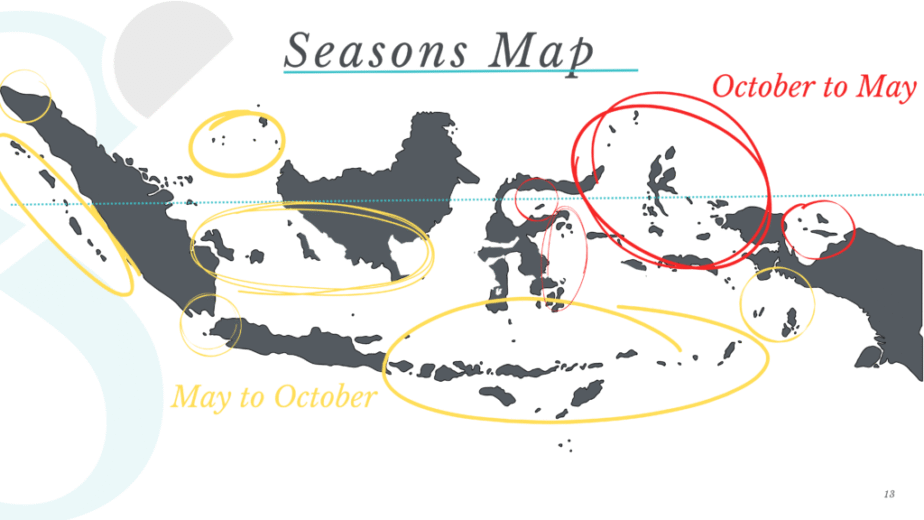
Extreme variations in rainfall are associated with the monsoon. There is generally a dry season (June to September), influenced by Australian air masses, and a rainy season (December to March) is the result of continental Asia and the Pacific Air masses. Western Sumatra, Java, Bali the interior of Kalimantan, Sulawesi and Irian Jaya is the wettest areas of Indonesia in a predictable manner, with a rainfall of more than 2,000 millimeters per year. In part, this moisture comes from a strategic location in the high peaks of the trap moisture in the air. The city of Bogor, near Jakarta, says that more global rainfall per year – 322. On the other hand, the islands closest to Australia – including Nusa Tenggara and the eastern tip of Java – tend to be dry, some regions have less than 1,000 millimeters per year.
To complicate matters, some of the South Moluccas experience highly unpredictable rainfall, depending on local air currents. Located in Ecuador, the archipelago experiences relatively little change in the length of daylight hours from one season to another, the difference between the longest day and shortest day of the year just 48 minutes. The archipelago stretches across three time zones: Western Indonesia Time – seven hours ahead of Greenwich Mean Time (GMT) – includes Sumatra, Java, Kalimantan and East Indonesia Time Central – eight hours head of GMT – includes western Kalimantan, Sulawesi and Nusa Tenggara, Indonesia and this time – nine hours ahead of GMT – includes the Moluccas and Irian Jaya. The boundary between the Western and Central time zones – established in 1988 – is a line to the north between Java and Bali through the center of Kalimantan. The border between the central and Eastern Time zone extends north of the eastern tip of Timor to the eastern tip of Sulawesi.
FAQ (Frequently Asked Questions)
What is the defining characteristic of Indonesia’s climate?
The defining characteristic of Indonesia’s climate is rainfall, rather than temperature or air pressure. Most of the country experiences relatively constant temperatures—averaging 26–28°C in low-lying areas—and relative humidity levels between 70 and 90 percent.
When do the dry and rainy seasons generally occur in Indonesia?
In general, Indonesia’s dry season runs from June to September, influenced by Australian air masses. Meanwhile, the rainy season occurs from December to March, driven by air masses from the Asian continent and the Pacific.
How many time zones are used in Indonesia?
Indonesia is divided into three time zones: Western Indonesia Time (WIB), which is seven hours ahead of GMT; Central Indonesia Time (WITA), which is eight hours ahead of GMT; and Eastern Indonesia Time (WIT), which is nine hours ahead of GMT.
FAQ (Frequently Asked Questions)
What is the defining characteristic of Indonesia’s climate?
The defining characteristic of Indonesia’s climate is rainfall, rather than temperature or air pressure. Most of the country experiences relatively constant temperatures—averaging 26–28°C in low-lying areas—and relative humidity levels between 70 and 90 percent.
When do the dry and rainy seasons generally occur in Indonesia?
In general, Indonesia’s dry season runs from June to September, influenced by Australian air masses. Meanwhile, the rainy season occurs from December to March, driven by air masses from the Asian continent and the Pacific.
How many time zones are used in Indonesia?
Indonesia is divided into three time zones: Western Indonesia Time (WIB), which is seven hours ahead of GMT; Central Indonesia Time (WITA), which is eight hours ahead of GMT; and Eastern Indonesia Time (WIT), which is nine hours ahead of GMT.
Where is the wettest and driest regions in Indonesia?
The wettest regions include West Sumatra, Java, Bali, the interior of Kalimantan, Sulawesi, and Irian Jaya, with annual rainfall exceeding 2,000 millimeters. The driest regions are Nusa Tenggara and the eastern tip of Java, with annual rainfall of less than 1,000 millimeters.
FAQ (Frequently Asked Questions)
How many seasons in indonesia?
Indonesia has two main seasons: the dry season and the rainy season.
The dry season generally runs from April to October, while the rainy season is usually from November to March.
When is the best time to visit Indonesia?
The best time to visit Indonesia is generally from May to September, during the dry season with sunnier weather and less rainfall.
For Bali and Java, May, June, and September offer a good balance of pleasant weather, fewer crowds, and better travel conditions.
How do temperatures vary across Indonesia?
Temperatures remain fairly constant across nearly 81 percent of Indonesia. Coastal plains average 28°C, inland and mountainous areas average 26°C, and high-altitude mountain regions average 23°C.
Which regions in Indonesia are the wettest and driest?
Western Sumatra, Java, Bali, the interior of Kalimantan, Sulawesi, and Irian Jaya are the wettest regions in Indonesia, receiving over 2,000 millimeters of rainfall annually. Conversely, the islands closest to Australia—such as Nusa Tenggara and the eastern tip of Java—tend to be dry, receiving less than 1,000 millimeters per year.
[…] UjungKulon National Park is a hidden Paradise of a tropical forest with endangered Flora and Fauna, beautiful white sanded beaches for surfing, snorkeling, fishing […]
[…] Avoid salads, raw vegetables and fruits, unless you have peeled […]
[…] understands if Java island is one of the five biggest islands in Indonesia. The populated island with more than a half Indonesian people live in. The 280 millions population […]
[…] April to October brings the driest weather across Java and Bali. July, August and the Christmas–New Year window see the highest prices and crowds. Shoulder months often deliver better value and fewer people at the temples. See also best time to visit Jakarta and seasons in Indonesia. […]